Mothering and Lockdown

by Dipontseng Kheo

(all mothers quoted here gave their consent)

As parents it is natural to want to protect our children from anything that could possibly harm our young ones. Pregnant mothers are feeling anxious about their unborn babies from this deadly virus.

I read an article about a woman who tested positive for COVID-19 in Belgium, just before giving birth to a healthy baby girl, and now must learn to care for her new-born infant with a mask on. She spoke about the pain of giving birth alone and not being able to see her other children.

When the lockdown was announced in South Africa, my children were still with my parents in Vereeniging, away from where I live. I also had started an online course which had about ten modules and back-to-back assessments. So, I decided to let them stay with my parents so that I could focus on my course and finish administration work I took home before the lockdown. Then COVID-19 statistics gradually went up and the lockdown was extended.

I started receiving homework for my children, one in Primary School and the other in High School. Then social media friends and family started posting activities with their young ones, and today’s slang FOMO (Fear of Missing Out) kicked in. Together with my partner, we decided we would have to fetch the kids. I went to the Police Station to get a permit, but under the regulations only divorced parents who were co-parenting were allowed a permit. The officer advised I write an affidavit stating my reasons. He also highlighted that if I met a roadblock, the law enforcement officials could send me back to Pretoria rather than allowing me to continue with my journey. Well to cut long story short, I managed to fetch the kids, no roadblocks.

For the first three days I was still excited that they were back and I started with trending activities like baking, cooking and exercising together. Some of these were activities we’d never really had time to do together before. In this first week I didn’t touch any school work. By week two I was exhausted, irritable and frustrated. I somehow felt I was not in control and had to try and create a routine. This was not exactly how I’d imagined things. From house chores to cooking, being a judge, doing homework, being a wife and working from home, I was drained. I recall telling our Deputy Director that I needed counselling because I was overwhelmed.

We are not used to being around our kids twenty-four hours a day, seven days a week, except for some weekends. I came up with a routine to follow but we rarely followed it. I found new admiration for the patience of teachers; home schooling is really draining if you don’t have that love and patience for teaching. And it’s even worse when you don’t have a clue about what is being taught. I didn’t do EGD (Engineering Graphics and Design) and my Grade 8 daughter asked me to help her. I really didn’t have a clue and that really frustrated me. I thought of finding a tutor, but at the same time I was worried about their wellbeing. What if the very same tutor infects my children with this virus, a virus that’s really got us overthinking? So, we opted for online lessons; it was a bit of a challenge in the beginning, with one laptop, but eventually we found a way around it.

I started speaking to other women to see how they were coping during lockdown. That really helped and gave me the strength to come out of the negative shell I had created for myself.

This is what they had to say:

“As coronavirus was strengthening its grip on the world, we all watched with fear and anxiety. I saw the declaration of a total lockdown of the country in a positive light because at least I knew that staying at home, and not leaving to meet with other people, would actually delay or prevent myself and my children from contracting the virus.

Spending time with my kids proved to be an excellent experience as we spent the time doing small things which mattered the most to each one of us. New routines and habits were formed.

We exercised together, did cooking lessons, cleaned the house, worked in the garden and played together. Most of which are activities we never had enough time to perform before.

The only challenging experience was that of having to ‘homeschool’ the kids. First was the issue of not having enough data to log on to online classes, then we had to print out worksheets which was an impossible task as all shops were closed.

In a nutshell, for me this proved to be a great time for me and my kids to spend together and it allowed us to explore and express our individuality in many different ways.”

Khahliso Zulu, Pharmacist Manager

“As an essential worker I thought life would still be the same at home during lockdown, but only to find out it’s not going to be easy at all.

Being a mother, I had to leave my daughter with Daddy every weekday for work, but will most of the time be on the phone with them, regarding school work issues and making sure when she is home she still acts responsibly.

One beautiful thing about lockdown was that my 11-year-old daughter learned so much regarding house chores, because I would give her things to do after doing school work, then on weekends she will keep on doing all those helping Mommy. This was not an easy time for everybody but again we managed to bond a bit compared to when the world was normal.”

Dikeledi “DK” Letsiri, SABC radio & TV sports presenter

“I have always known myself to be a ‘jack of all kinds’ of mom but have come to realise that in these trying times even super heroes need time out. It has been very challenging to juggle between working from home and home schooling, while trying to keep it together and be prayerful that we keep the family safe from this pandemic. We have all had to adapt, and most importantly, we have to keep sane while trying to avoid stuffing our faces, even though I am trying out new recipes all the time! We might just end up rolling out of this lockdown…lol. I salute all moms out there! Keep being the best mom you possibly can be.”

Evodia Lenong, Policy Administrator

Based on these views of different mothers working from home, or as essential workers, we just have to figure out what works just to be sane during this pandemic.

I must say I am eventually getting the hang of things only weeks later. We still exercise, play games and meditate together. It’s up to an individual to view lockdown from a negative or positive perspective. What works for me might not work for you. Yes, these days are not the same but we still have to look ahead and create a better future for us and our children.

In conclusion, I will like to remind mothers that they should not be hard on themselves. This lockdown is new to everyone and all you’ve got to do is just try to do the best you can. If you are not coping, speak to someone you trust. Free counselling is provided for many many employees, reach out.

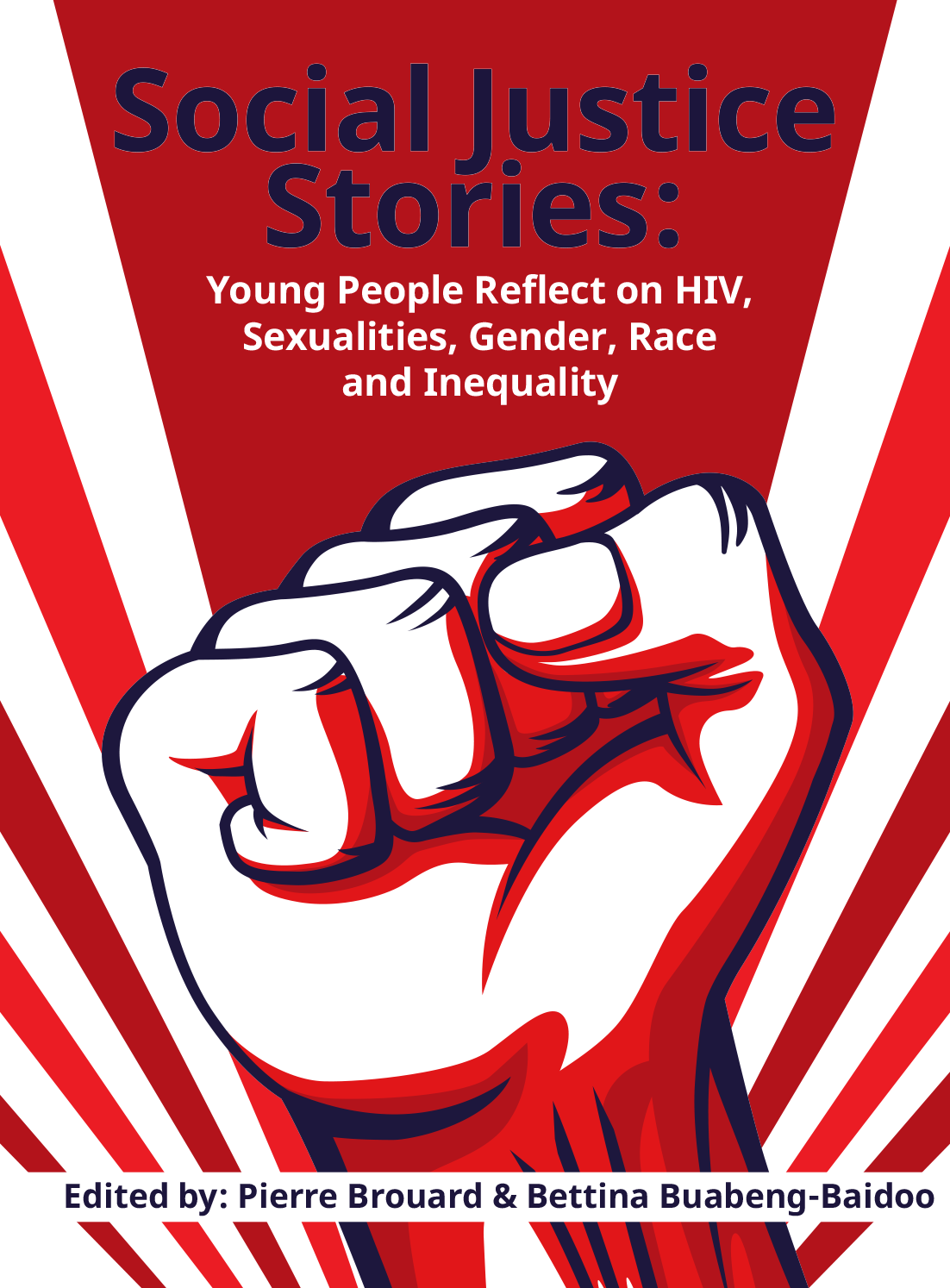
Launch – Social Justice Stories: Young People Reflect on HIV, Sexualities, Gender, Race and Inequality

When final year medical student Bettina Buabeng-Baidoo approached the Centre for Sexualities, AIDS and Gender (CSA&G) at the University of Pretoria (UP), in her role as Fundraising Officer in the South African Schools Debating Board (SASDB), to collaborate on a social justice writing competition for high school learners, we were very excited.

The South African Schools Debating Board is a non-profit organisation which facilitates World School Style debating in the nation. The SASDB believes that debating and public discourse are pivotal tools in creating a more tolerant and equal society.

The CSA&G runs a social justice project for students at UP, Just Leaders, and we have learned that the energy, enthusiasm and sense of justice in young people is infectious, and critical to a functioning society based on freedom of speech, fairness and dignity, determined to redress the imbalances of the past.

This volunteer programme, funded by the Students and Academics International Assistance Fund (SAIH), aims to build an inclusive UP, one which recognises that differences around class, ability, socio-economic status, gender, sexuality and race still matter in who arrives at, and succeeds in, the University. The Fees Must Fall movement was an earthquake for the tertiary sector, in its aftermath there is still much work to be done.

This social justice writing competition was Bettina’s brainchild; building on her work with the SASDB where she coaches young people in debating skills. This marriage of her interests and the CSA&G’s ethos has been a happy one. Together we developed a call for schools in Gauteng to send teams of Grade 10 – 12 learners, accompanied by their debating teacher, to a one-day workshop on social justice. The workshop was hosted with the generosity of Crawford College in Pretoria and we especially single out Yvonne Reddy for her support for the day.

Run by volunteers of the Just Leaders programme, the workshop explored human rights and social justice in South Africa, and then homed in on themes of race, inequality, HIV, sexualities and gender as exemplars of work that still needs to be done in South Africa to realise the dream of an equal and fair society.

Participants in this workshop were then invited to write and submit an essay which had social justice as its theme. While they were encouraged to write on the themes of the workshop, any essay which explored justice in post-Apartheid South Africa was eligible. We selected the most promising essays, provided feedback for re-writes and revisions where necessary, and helped to polish them lightly so that they shine. We did not select winners or runners up for this exercise, but chose to showcase a cross section of stories instead: the entries appear in no particular order.

It is important to note that we obtained full consent from the essay writers and their parents/guardians for these stories to be published.

This consent was important because we discovered that the learners did not hold back! HIV diagnoses, rape, gender violence, questionings around sexual orientation and gender identity, provocations around race (did it still matter today – definitely said one writer, it shouldn’t said another) and questions of privilege and culpability come up in these stories. There is a rawness to some of them and while they don’t reflect the views of the CSA&G, the SASDB, or the schools from which the learners are drawn, we are also passionate in our defence of their right to have their say. These are their views, their stories and we are proud of them. We hope you will be too.

Publication launch: Just Leaders – sharing their reflections on social justice

Just Leaders and social justice

The Just Leaders project was launched in 2018 as a flagship programme of the Centre for Sexualities, AIDS and Gender at the University of Pretoria. Just Leaders draws on the student body and “endeavours to build a movement of active citizen student leaders that promote social justice, critical consciousness and inclusive practices at the University of Pretoria and supporting similar movements at partner universities in the region,” (CSA&G, 2020). Through its focus on student-led and informed research, advocacy and support of intersectional social justice, the Just Leaders programme develops justice-driven leadership that works to improve and sustain inclusive tertiary environments.

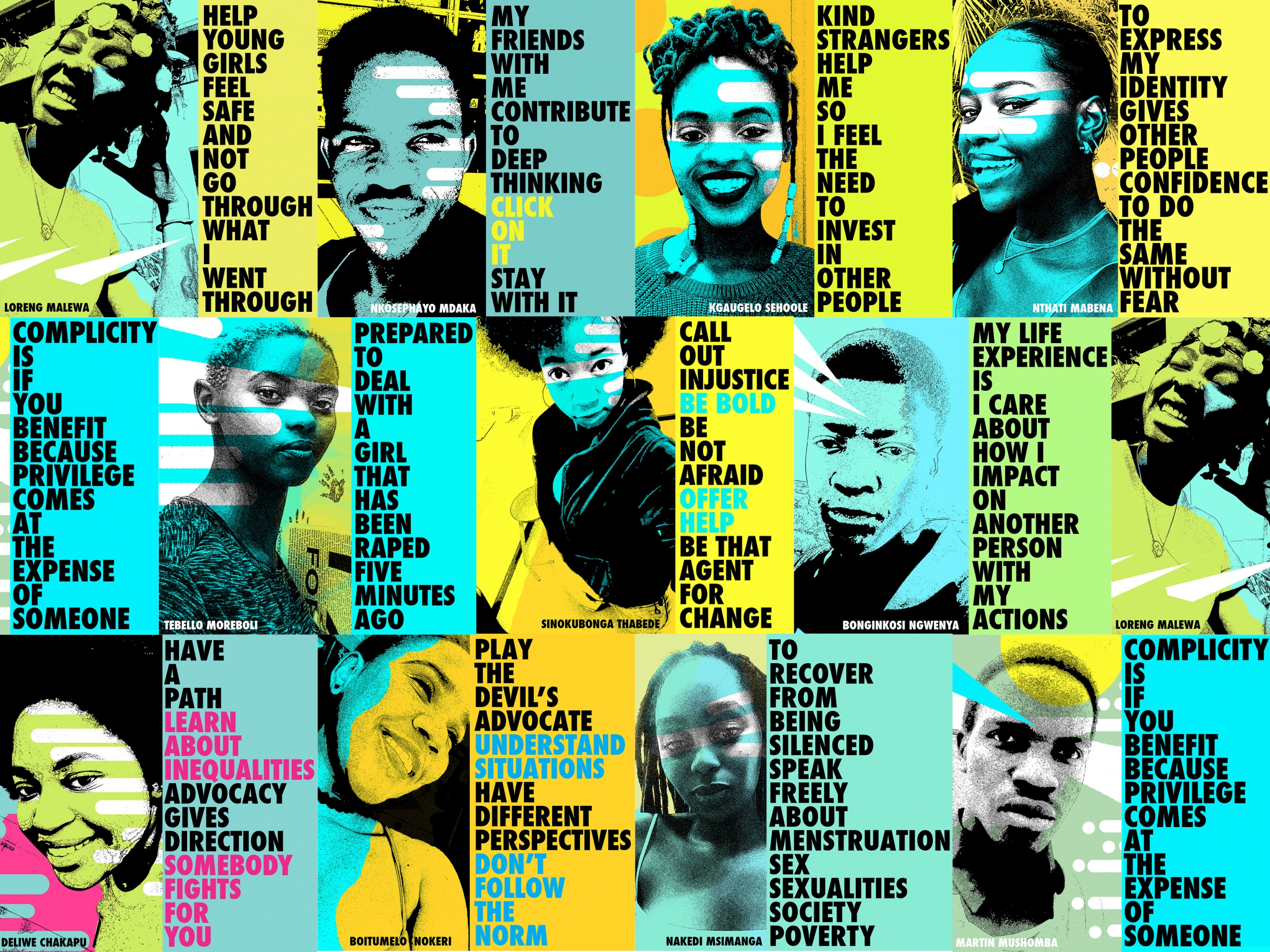
The collection of designs that follow in this publication flows from one such Just Leaders initiative. Together with artist and activist Brenton Maart, the Just Leaders research cohort of 2019 gave expression to their own understandings, interpretations and critiques of the notion of “social justice”. Over the course of a year the students engaged in a series of workshops around themes of social justice, political citizenship, activism, agency and intersectionality. Along with the theoretical components of these workshops, the students, under Maart’s guidance, also acquired skills and methods including photovoice and visual literacy.

The outcome of the project challenges its audience to engage with young leaders, not through mediated or second-hand accounts of their experiences and perceptions of social justice, but in their own words. The photos used were taken by the students themselves – self-portraits capturing what appear to be everyday moments – and the text that accompanies the pictures stems from conversations with the students. Together these designs ask of us to rethink not only the supposed limits of student research, but also challenges us to engage in intimate ways with the thinking of the CSA&G’s Just Leaders.

Just Leaders and Black Lives Matter: thoughts and reflections from CSA&G staff

By Pierre Brouard, Chris Jourbert, Vuyisa Mamanzi and Tumelo Rasebopye

Pierre Brouard – introduction

Pierre BrouardIt would be an underestimation to say that we are caught up in a critical global moment around racial justice – well it feels global, though it might be true to say that beyond Covid-19, other parts of the globe are caught up in their own social justice struggles (Hong Kong, China, India, Russia come to mind). The struggle I am referring to is the Black Lives Matter (BLM) protest movement in the US, in the wake of the killing of George Floyd, echoed by mass protests in many countries, especially the UK where the disproportionate policing of black bodies has always been an issue.[1]

In South Africa we have also seen protests in support of the BLM movement, and our government has made a call for three consecutive “black Fridays” in solidarity with BLM. Our own context has brought an added nuance, in that there have been protests around the killing of Collins Khoza and others in the wake of heavy handed lockdown enforcement. In the private school, and Model C sector there are calls from many former and current black students for a reckoning around schools which are racist and have had a history of exclusion. This is not a new phenomenon, but I believe the current wave of protests is inspired by BLM; they are a call for long overdue action in the many private schools struggling to transform.

However a young black man of my acquaintance was scathing about these private school protests, calling them out for what he said was their middle class privilege.

Writing in the Mail and Guardian[2] , William Shoki argues that a class analysis offers a better insight into current forms of oppression here. Noting that South African incidents of police murder in this country, per capita, are actually three times higher than in America, Shoki suggests that the role of the police as a professional body of law enforcers is not a response to crime, but is a response to the threat that collective [working class] action poses to elite rule, and the unequal social arrangements which undergird it.

Identification with the victimisation of black Americans, he says, “reveals an unwillingness to confront the class character of police repression. So long as there is a capitalist state entrenching private property relations, there will always be some kind of security apparatus to defend it”. In the US this has racism coded into its logic of operation, and in South Africa, class relations.

What we need to do, he suggests, is to embrace and channel rage and protest towards the objective of a better world beyond capitalism.

Of course he is not arguing that the anti-racism project in South Africa is complete, nor that we should not support Black Lives Matter protests. Our history of Colonialism and apartheid harm means that we are still not transformed. I have worked in the school setting and many black students speak movingly, and with anger, about micro aggressions and racism (conscious and unconscious) that they see and feel every day. George Floyd’s death was a trigger, Shoki’s analysis notwithstanding, for many South Africans, mostly black South Africans it could be argued, who feel, at a deeply personal and visceral level, the hurts and rage of history, far and recent.

Here are some thoughts and feelings from CSA&G colleagues on these recent events.

Chris Joubert

Chris JoubertI think people often forget how influential identity truly is. It is easy to tell someone to not care about what others think of you.   How well does that truly work?  What happens when those who are meant to lead and protect a society, show you time and time again that some members of that society are valued less than others?.

Society teaches us that some people do not matter. That it is OK to treat some people poorly and not see them as people, but less than people.

From a young age, it was made clear to me, that the colour of my skin makes me less than human. That sounds dramatic to some people but let me walk you through it.  I was born in foreign country and lived there for most of my childhood. The reason for that was that it was immoral and illegal for my parents to be in a relationship. The country both my parents come from deemed interracial couples to be unnatural, immoral, and therefore illegal. This meant if my parents wanted to be with each other and with their children, they would need to flee from their home and take refuge in a foreign land.

At my school, a teacher told me that I should feel privilege to be in that school, because it gave me an opportunity to be outside of the dangerous area “from where I came”, not knowing that I lived close to that school. It is the same school where a learner told me that the “great thing” about me is that while I look black, I at least have the brain of a white person.

As a teen driving with my brother and father, we got pulled over by the police and my dad was asked if he was being hijacked, while my brother was being searched by the police. To their mind, we were not a family driving together but rather two coloured men hijacking a white man.

These are some examples of racism that I have experienced. From these and many more experiences, I learned that society sees me and people who look like me as criminals, dangerous, violent, and intellectually inferior.

When people say black lives matter, what they are saying is that for centuries the lives of black people have been seen as less valuable than other lives. And now the lives of black people should be valued, respected, and protected as much as other lives have been.

Vuyisa Mamanzi

Vuyisa MamanziWhether listening to a radio talk show, watching a docuseries, reading a newspaper or an academic article, I often hear social justice activists and scholars influenced by the works of Paulo Freire reiterate the following words: “The structure is still exactly the same, only, it has become even more efficient in terms of oppression.”

However, what might have changed at a superficial level is who are the oppressed. The world all over is confronted and turned upside down by the Covid-19 pandemic. In the midst of this crisis we are once again witnessing high levels of police and army brutality, both in the United States and right here at home in South Africa.  Two cases that have dominated media headlines recently are the killings of two black men.  The death of Collins Khosa of Alexandra Township, South Africa, and the death of George Floyd of Minneapolis, Minnesota, United States. These cases are similar, yet different.

In South Africa Collins Khosa died after being assaulted at home by SANDF soldiers, who have since been cleared of the charges, despite a post mortem report stating that Khosa had died of blunt force trauma to the head (Venter, 2020). George Floyd has died as a result of a police officer placing his knee on Floyd’s neck, for nine minutes, resulting in his death (The Indian Press, 2020). These tragic incidents drive one to think deeply about of the concept of “locus of enunciation”, in how one tries to think, understand and make sense of these  killings of two black men, in different parts of the world. Locus of enunciation, is a concept coined by Walter Mignolo (2007) and broadly understood as “to think from where you are located” (Mignolo, 2002). Ngungi wa Tiongo speaks about it in terms of the base: “how we see a thing even with our eyes is very much dependent on where we stand in relation to it” (Ndlovu-Gatsheni, 2018).

As a black South African woman, how do I think of, make sense of, and even speak of, the death of Collins Khosa, in particular? Living in what is said to be a democratic South Africa, led by a black government. And, I wonder how those in the global north, think of, make sense of, and speak of, the death of George Floyd in a Trump-led country.

Being situated in South Africa, my history and the events leading up to the death of Khosa, forces me to think deeply and critically about our struggles in Africa. Kwesi Prah reminds us of an elite who has inherited and extended the lease of life of the colonial culture. An African elite who has integrated themselves and trying to get a position on the table of western culture. Since the dawn of democracy Kwesi Prah argues that we have succeeded in sending our kids to their schools, learn their languages, speak like them, like the things they like, eat exactly what they eat and drink what they drink.

He pushes it  further by stating that when we do all these things COLOUR does not save us, instead we become part of a culture. He posits that human beings are cultural animals and in South Africa we have succeeded in integrating ourselves into a particular culture (Prah, 2017). Therefore as we think, make sense of and try to understand the death of Collins Khosa, we must remember that our struggle in Africa is not just about race. Instead it is to lift the condition of our history, our culture, our, languages, our heritage and place it at the centre, and that is not blackism, it is Africanism.  It is not just racism that we are fighting, we are fighting for the upliftment of the African history, culture, society, AFRICANS! The fact that most Africans are black does not make all blacks African (Prah, 2017).

Looking at both the cases of Collins Khosa and George Floyd I am reminded of James Baldwin’s words when he said “don’t try to be safe, nobody is ever safe…people are not wicked because they do wicked things. The reason I want to suggest it to you is because I want you to know that there is nothing that has been done to you that you are not capable of doing to someone else.” (Baldwin, 2017).

What we are witnessing in the United States currently in relation to the ongoing protests ignited by the murder of George Floyd is what Kwesi Prah would characterise as an African-American struggle to remove the privileges that whites have over blacks. Prah asserts that US politics and systems have dictated the terms of the freedom struggles of African-American people – a struggle formed around challenging white dominance and privilege – versus the freedom struggles in Africa where questions of identity, language and culture have predominated (Prah, 2017).

bell hooks, in her book titled Black Looks: Race and Representation, says because African-American people have been socialized within white supremacist educational systems and by a racist mass media, “many black people are convinced that our lives are not complex, and are therefore unworthy of sophisticated critical analysis and reflection. Even those of us righteously committed to black liberation struggle, who feel we have decolonized our minds, often find it hard to ‘speak’ our experience. James Baldwin understood this. In The Fire Next Time he reminded readers that ‘there has been almost no language’ to describe the ‘horrors’ of black life. Without a way to name our pain, we are also without the words to articulate our pleasure” (Hooks, 1992).

In their similarities and differences the tragic and unfortunate deaths of Collins Khosa and George Floyd in the hands of state should invite us as “critical thinkers to break with the hegemonic modes of seeing, thinking, and being that block our capacity to see ourselves oppositionally, to imagine, describe, and invent ourselves in ways that are liberatory. Without this, how can we challenge and invite non-black allies and friends to dare to look at us differently, to dare to break their colonizing gaze?” (Hooks, 1992:2).

Being involved in social justice work and activism, and as I witness different forms of injustices unfold during these trying times, I concur with Thuli Madonsela’s sentiments in an open letter she recently wrote to our President, stating that “the constitution requires that no section of society should be unjustly and unfairly excluded from opportunities, resources, benefits and privileges. No group should bear a disproportionate burden.”

Rather, we should build a society which tolerates, respects and treats cultural differences equally. And, remember that South African society has the ingredients for a truly cosmopolitan culture with contributory derivations from all parts of the world.

Tumelo “Duke” Rasebopye – Do #BlackLivesMatter in South Africa?

duke rasebopyeI have been a victim of police violence before and have had a front row seat at how brutal the police can be towards an innocent citizenry. First, in 2015, when a friend and I were arrested while commenting on the police’s violent interventions towards a line of people looking to buy food from a sidewalk vendor; second, later in 2015, during the #FeesMustFall protests, when students from higher education institutions across the country gathered peacefully at the Union Buildings and were ambushed with rubber bullets and teargas after having being called back by authorities for an apparent address by the President; and then in 2016 when we participated in peaceful protests advocating for fair labour practices and the equality of students in the teaching and learnings activities of the University of Pretoria.

What is clear is that #BlackLivesMatter raises an issue that is not just limited to acts of police violence and brutality towards black persons in the USA alone, but gives us an opportunity to interrogate what seems to be an institutional culture that is a cancer to the police’s reputation internationally. Yes, we have been here before, and so have generations before us, but one gets the sense that this time around it has gained a heightened level of attention, gaining allies from unexpected groups and sectors, and hopefully this will be significant enough for it to advance real change.

As wonderful as the support has been from South Africans, one can’t help but notice the overwhelming silence of South Africans towards the excessive force being exercised in our own country. It’s saddening to have seen people being shamed for having not posted anything about BLM while also noting the struggle of local activists in trying to bring attention to, and seek justice for, victims here.

The Covid-19 lockdown period has exposed the blatant racial bias that exists in the South African Police Service and the South African National Defence Force. We have seen the level of humiliation used towards black communities in reinforcing the lockdown regulations, we have seen the lengths that law enforcement has gone to in order to locate and arrest offenders who trended on social media. And we have seen the violence used in enforcing these regulations, resulting in death as well. This is not the same energy exercised towards predominantly white communities who may document their violations on social media as well.

Unlike in the USA, the violent enforcement of the law in South Africa is mostly perpetrated by black police officers. This makes it clear that we are not only dealing with a historically racist institution, but that it is so structurally violent that it no longer matters what the race of the police officer is.

The institution remains mostly violent towards black people and black communities in particular and seems to reserve the serving and protecting for white people, privileged persons with power, and those communities and persons who present an association with or proximity to whiteness.

It truly is a joy to have activism reach such levels globally and that groups that have been marginalized historically and structurally today have found a collective voice to call for justice where offences exist, and social justice in its entirety wherever they may live, work or find leisure. The reality is that the hashtag will probably lose traction, the following will reduce significantly, and people will likely return to this issue when someone else dies and we find ourselves outraged by seeing the video on the internet.

There is still a lot of activism needed before we can claim success or any progress towards dismantling this system, but we need to start getting angry at our own institutions here in South Africa and start demanding accountability for the injustice, violence and racial profiling that continues to exist in our country. Especially considering that it is the majority in this instance that remains oppressed and still dies due to the service it receives from the police.

Bibliography

Baldwin, J. (2017). Baldwin Speech: Living and growing in a white world

https://www.youtube.com/watch?v=QWF2Wjie7Vs

Hooks, b. (1992). BLACK LOOKS: race and representation. South End Press. Boston, MA

https://aboutabicycle.files.wordpress.com/2012/05/bell-hooks-black-looks-race-and-representation.pdf

Mandonsela, T .(2020). Dear Mr President – open letter from Thuli Madonsela is going viral!

https://www.goodthingsguy.com/opinion/dear-mr-president-open-letter-from-thuli-madonsela-is-going-viral/

Mabhena, C. (2019). On the Locus of Enunciation

https://www.sundaynews.co.zw/on-the-locus-of-enunciation/

Ndlovu-Gatsheni, S.J (2018). THE DYNAMICS OF EPISTEMOLOGICAL DECOLONISATION IN THE 21ST CENTURY: TOWARDS EPISTEMIC, FREEDOM. Strategic Review for Southern Africa, Vol 40, No 1. Change Management Unit (CMU) University of South Africa, Pretoria

https://www.up.ac.za/media/shared/85/Strategic%20Review/vol%2040(1)/Ndlovu-Gatsheni.pdf

Prah, K, P. (2017). Has Rhodes Fallen? Decolonizing the Humanities in Africa and Constructing Intellectual Sovereignty. The Academy of Science of South Africa (ASSAF) Inaugural Humanities Lecture. HSRC, Pretoria.

https://www.assaf.org.za/files/ASSAf%20news/Has%20Rhodes%20Fallen.docx%20ASSAF%20Address%2015.2.2017.pdf

Prah, K, P. (2018). The challenge of language in post-apartheid South Africa.

https://www.litnet.co.za/challenge-language-post-apartheid-south-africa/

The Indian express (2020). Explained: Why George Floyd’s death sparked violent protests across the United States

https://indianexpress.com/article/explained/george-floyd-death-violent-protests-explained-6434207/

Venter, Z (2020). Soldiers cleared of Alexandra man’s murder

https://www.iol.co.za/news/south-africa/soldiers-cleared-of-alexandra-mans-murder-48630266

Walter, D. M (2002). The Geopolitics of Knowledge and the Colonial Difference

http://www.unice.fr/crookall-cours/iup_geopoli/docs/Geopolitics.pdf

Footnotes

[1] See here https://www.release.org.uk/publications/ColourOfInjustice for a report on this

[2] https://mg.co.za/opinion/2020-06-01-the-class-character-of-police-violence/

 

Is it or is it not LGBTIQ+ Pride Month in South Africa?

By Johan Maritz

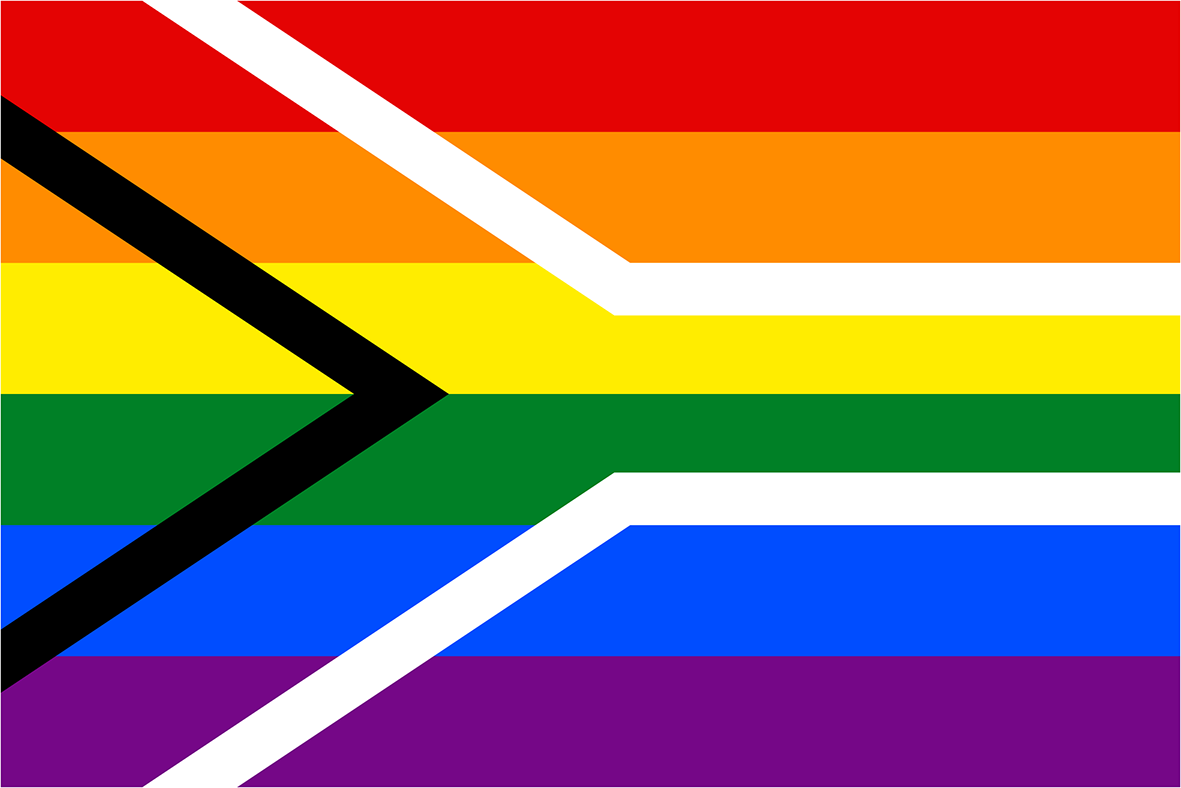
SA LGBTIQ+ flag

My news feeds on different social media platforms have, since 1 June, been proclaiming that June is Pride Month. Many organisations and groups have now declared June as LGBTIQ+ Pride Month in South Africa and beyond.

I am perplexed by this, as it is indeed Pride Month, but in the US! Pride Month in the US is a commemoration of the Stonewall riots that occurred on 28 June 1969[1]. Police officials from New York City’s Public Morals Division conducted a raid on the Stonewall Inn in Greenwich Village, New York, on that day. This happened regularly but on that day patrons decided they had enough and decided to fight back. Riots ensued, patrons from neighbouring bars joined the fight, cars were set alight, windows were smashed and police ended up having to barricade themselves in the Stonewall Inn. The protest lasted six days! This moment in history[2] is regarded by many as the birth of the gay liberation movement and the start of the fight for LGBTIQ+ equality in the US.

Has Pride in South Africa and around the world become Americanised?

According to French sociologist Frédéric Martel, this is not necessarily the case:

“Gay people are increasingly globalized and often very Americanized, but they remain deeply rooted in their individual countries and cultures. In the era of globalization, openness to influence and rootedness in history are not mutually exclusive. Indeed, the local singularities of gay life and the heterogeneity of LGBTQ+ communities are strong, even when sheltered under the same flag.”[3]

I don’t disagree with Martel, and I accept that local queer movements can and should be African in ethos AND inspired by events in other places, but there are other celebrations in June which may complicate things.

June is Youth Month in South Africa. On 16 June, we commemorate the 1976 Soweto Youth Uprising when young people stood up against the Apartheid government’s directive that Afrikaans alongside English was a compulsory medium of instruction.[4]

Are we inadvertently setting up competing interests through combined commemorations? Do we run the risk of dividing resources, splitting our energies unnecessarily, by allowing Pride Month and Youth Month to overlap?

That may be so, and time will tell. But this may also be an opportunity for LGBTIQ+ youth to be celebrated during Youth Month. LGBTIQ+ youth’s liberation struggle is far from over, with several reports about homophobia and instances of hate crimes against young members of the LGBTIQ+ community. A case and point is the brutal stabbing to death of LGBTIQ+ teen Liyabona Mabishi on Human Rights Day in Khayelitsha this year[5].

The fact that young LGBTIQ+ people are still facing challenges in a post-Apartheid South Africa is disappointing, there is still much work to do. Just as the youth of 1976 rose up against a system which oppressed them, young queer people need to rise up against the oppression many still face today. And they should not have to do that on their own. June could be celebrated and Youth Pride Month.

Here I would like to make a special plea for the role of older LGBTIQ+ people, as people who have wisdom and insight, and who can mentor and support their younger counterparts. Many older people will have lived through enormous legal change: in the addendum to this piece I attach a list of key events that have shaped LGBTIQ+ life in South Africa.

So, when should Pride Month be in South Africa?

I think that the perfect month for LGBTIQ+ Pride would be October, to commemorate the first South African and African Pride event. This was a significant undertaking and not without risk for the 800 or so people who participated.  It was South Africa before democracy and homosexuality was still illegal. This ground-breaking event was inclusive[6] and was also a protest against Apartheid.

In my view, 13 October 1990, is a day that should be remembered and celebrated.

June can be LGBTIQ+ Pride Month if you want it to be. Hopefully it carries meaning for you. As LGBTIQ+ citizens we are also global citizens and there are benefits to having a more global sense of celebration like greater visibility, but please remember that the right to celebrate and exist was a result of a long struggle and that this struggle continues for many members of this global community. Also remember South Africa’s unique LGBTIQ+ history and we celebrated many liberation victories long before the US and the world did. Your pride should boldly include its South African history and many victories. Pride is also not a justification for complacency as the LGBTIQ+ struggle in South Africa is far from over.

Key events that have shaped LGBTIQ+ life in South Africa

I often feel that South African LGBTIQ+ youth do not know enough about their LGBTIQ+ history and perhaps the marginalisation of ‘older’ LGBTIQ+ voices plays a role in this. Here are some dates[7] which might add gravitas to Pride Month, whenever it is celebrated!

January 1966: The Forest Town Raid – police raided a party in Forest Town, Johannesburg. Nine men were arrested for masquerading as women and participating in ‘indecent activity’. This resulted in a lot public and political scrutiny, ultimately resulting in the Immorality Amendment Act of 1969.

21 May 1969: Immorality Amendment Act of 1969 – introduces Section 20A, with the infamous ‘men at a party’ clause, which prohibited two or more men from being together and performing any act that would arouse ‘sexual passion’. The amendment also raised the age of consent for male homosexual activity from 16 to 19, although ‘sodomy’ and ‘unnatural acts’ were already criminal. The objective of the government was to minimise the presence of homosexuals, and protect society from the ‘corrupting influence’ of the LGBT community.

1971 to 1989: The Aversion Project – homosexual soldiers in the South African Defence Forces (SADF) were forced to submit to ‘cures’ for their homosexuality.

4 March 1988: Immorality Amendment Act of 1988 – imposes an age of consent of 19 for lesbian sex, which had previously been unregulated by the law. This was higher than the age of 16 applying to heterosexual sex.

13 October 1990: The Lesbian and Gay Pride March – South Africa’s first Lesbian and Gay Pride march was held on this date in Johannesburg. It was the first Pride March on the African continent and acted as both a gay pride event and an anti-Apartheid march. The march was organised by the Gay and Lesbian Organisation of the Witwatersrand (GLOW) and attracted a crowd of about 800 people. Speakers at the event included Beverly Ditsie, Simon Nkoli and Justice Edwin Cameron. The purpose of the event was not only to demonstrate pride in gay or lesbian identity but also to provide a wider platform for voicing political concerns. The march was part of a broader struggle to decriminalise homosexuality in South African law and to end Apartheid.

27 April 1994: Interim Constitution – the Interim Constitution comes into force. It includes a clause explicitly prohibiting discrimination on the basis of sexual orientation, giving LGBT South Africans legal protection for the first time. A subsequent court decision in 1998 will establish that the crime of sodomy was legally invalid from this date.

4 February 1997: Constitution – the final Constitution comes into force, including the same anti-discrimination protections as the Interim Constitution.

8 May 1998: Sodomy and ‘unnatural sex acts’ – in the case of National Coalition for Gay and Lesbian Equality v Minister of Justice, a judge of the Witwatersrand Local Division of the High Court declares the criminalisation of sodomy and ‘unnatural sexual acts’, and section 20A of the Sexual Offences Act, to be unconstitutional for violating the anti-discrimination clause of the Constitution.

9 October 1998: Constitutional Court confirmation – the Constitutional Court unanimously confirms the judgment of the High Court in the National Coalition case.

12 February 1999: Immigration – in the case of National Coalition for Gay and Lesbian Equality v Minister of Home Affairs, three judges of the Cape Provincial Division of the High Court rule that it is unconstitutional for the government to provide immigration benefits to the foreign spouses of South Africans but not to the foreign same-sex partners of South Africans. The declaration of invalidity is suspended for one year to allow Parliament to correct the law.

2 December 1999: Constitutional Court confirmation – the Constitutional Court unanimously confirms the judgment of the High Court in the second National Coalition case, but removes the suspension of the order and instead ‘reads in’ words to the law to immediately extend immigration benefits to same-sex partners.

28 September 2001: Adoption – in the case of Du Toit v Minister of Welfare and Population Development, a judge of the Transvaal Provincial Division rules that same-sex partners must be allowed to jointly adopt children and to adopt each other’s children, a right which was previously limited to married spouses.

10 September 2002: Constitutional Court confirmation – the Constitutional Court unanimously confirms the judgment and order of the High Court in the Du Toit case.

18 October 2002: Marriage – in the case of Fourie v Minister of Home Affairs, a judge of the Transvaal Provincial Division dismisses the application of a lesbian couple to have their union recognised as a marriage on the grounds that they failed to attack the constitutionality of the Marriage Act.

31 October 2002: Natural parents – in the case of J and B v Director General, Department of Home Affairs, a judge of the Durban & Coast Local Division of the High Court rules that a child born to a lesbian couple must be regarded as legitimate in law, and that both partners must be legally regarded as natural parents of the children and recorded as such on the birth register.

28 March 2003: Constitutional Court confirmation – the Constitutional Court unanimously confirms the judgment and order of the High Court in the J and B case.

31 July 2003: Marriage appeal – the Constitutional Court refuses leave for a direct appeal in the Fourie case, directing that the appeal should instead be heard by the Supreme Court of Appeal.

15 March 2004: Sex description – the Alteration of Sex Description and Sex Status Act, 2003 comes into force, allowing transgender and intersex people to change their legally recognised sex.

July 2004: Marriage Act – the Lesbian and Gay Equality Project launches a case in the Witwatersrand Local Division challenging the constitutionality of the provisions of the Marriage Act that limit marriage to opposite-sex couples.

30 November 2004: Marriage – a five-judge panel of the Supreme Court of Appeal hands down a judgment in the Fourie case. The majority of four rules that the common-law definition of marriage must be extended to include same-sex marriages but that such marriages cannot be solemnised in South Africa until the Marriage Act is amended, either by Parliament or by the Equality Project’s application. The judgment is appealed to the Constitutional Court by both parties.

11 March 2005 Marriage – the Chief Justice instructs that the Equality Project case will be heard by the Constitutional Court simultaneously with the Fourie case.

1 December 2005: Marriage – the Constitutional Court delivers its judgment in the Fourie and Equality Project cases (now known as Minister of Home Affairs v Fourie). The court rules that the common-law definition of marriage and the Marriage Act are unconstitutional because they do not allow same-sex couples to marry. The court suspends its order for one year to allow Parliament to rectify the discrimination.

31 March 2006: Spousal inheritance – in the case of Gory v Kolver NO, a judge of the Transvaal Provincial Division rules that a same-sex life partner is entitled to inherit from the intestate estate of the other partner as if they were married.

August 2006: Marriage – the government rejects a call by the African Christian Democratic Party for a constitutional amendment to reverse the Constitutional Court’s decision on same-sex marriage. Cabinet approves the introduction of the Civil Union Bill in Parliament.

13 September 2006: Marriage – legal but not equal – the Civil Union Bill is introduced in the National Assembly. As originally drafted, the bill would provide for ‘civil partnerships’, for same-sex couples only, which would have the same legal consequences as marriage but would not be called marriage.

14 November 2006: Marriage – legal and equal – the National Assembly passes the Civil Union Bill, with amendments to allow marriages or civil partnerships available to same-sex and opposite-sex couples, by 230 votes to 41.

23 November 2006: Constitutional Court confirmation – the Constitutional Court confirms the judgment and order of the High Court in the Gory case.

28 November 2006: Marriage – the National Council of Provinces passes the Civil Union Bill by 36 votes to 11.

29 November 2006: Marriage/Civil Unions – the Civil Union Act, 2006 is signed into law by Acting President Phumzile Mlambo-Ngcuka.

1 December 2006: Marriage – the first legal same-sex marriage is performed, in George.

16 December 2007: Age of consent – the Criminal Law (Sexual Offences and Related Matters) Amendment Act, 2007 comes into force, equalising the age of consent at 16; previously it had been 16 for heterosexual sex and 19 for homosexual sex.

31 March 2008: Age of consent – in the case of Geldenhuys v National Director of Public Prosecutions, the Supreme Court of Appeal rules that the erstwhile difference in the age of consent was unconstitutional, notwithstanding that it has already been rectified by Parliament.

26 November 2008: Constitutional Court confirmation – the Constitutional Court confirms the order of the Supreme Court of Appeal in the Geldenhuys case.

18 December 2010: Flag – a gay pride flag of South Africa is launched in Cape Town.

Mid-March 2010: National Task Team – the establishment of a National Task Team (NTT) to address the issue of hate crimes against LGBT people such as corrective rape is mandated by then Minister of Justice Jeff Radebe.

29 April 2014: Intervention Strategy – the National Intervention Strategy for the LGBTI Sector developed by the NTT is launched by then Minister of Justice Jeff Radebe.

25 May 2014: Cabinet – Lynne Brown becomes the first openly gay person to be appointed to a cabinet post in any African government.

References:

Martel, F. 2018. How Pride Became a Global Phenomenon. Available online: https://www.them.us/story/how-pride-became-a-global-phenomenon [accessed 2 June 2020]

South African History Online. 2014. The History of LGBT legislation. Available at: https://www.sahistory.org.za/article/history-lgbt-legislation [accessed 2 June 2020]

South African History Online. 2017. The First Gay Pride March is Held in South Africa. Available at: https://www.sahistory.org.za/dated-event/first-gay-pride-march-held-south-africa [accessed 2 June 2020]

Thompson, B. 2020. The History Of Pride Month And What It Can Teach Us About Moving Forward Today. Available online: https://www.forbes.com/sites/brianthompson1/2020/06/01/the-history-of-pride-month-and-what-it-can-teach-us-about-moving-forward-today/ [accessed 2 June 2020]

Footnotes:

[1] The History Of Pride Month And What It Can Teach Us About Moving Forward Today. https://www.forbes.com/sites/brianthompson1/2020/06/01/the-history-of-pride-month-and-what-it-can-teach-us-about-moving-forward-today/

[2] https://en.wikipedia.org/wiki/Stonewall_riots

[3] https://www.them.us/story/how-pride-became-a-global-phenomenon

[4] https://www.sahistory.org.za/article/june-16-soweto-youth-uprising

[5] Western Cape LGBTIQ+ teen stabbed to death. http://www.lovenothate.org.za/2020/03/26/lgbtiq-teen-stabbed-to-death/

[6] Many subsequent Pride events in different parts of the country have been criticized for not being inclusive enough and with their representivity questioned.

[7] Adapted and consolidated from: https://en.wikipedia.org/wiki/Timeline_of_LGBT_history_in_South_Africa

Give a woman a fish

By Christi Kruger

In his book, Give a Man a Fish: Reflections on the New ‘Politics of Distribution’ (2015), James Ferguson discusses the politics surrounding social grants in the Global South at length.

He argues that the big “development story” of the last twenty years is not, as many scholars would argue, the story of microfinance but rather of “the rise and rise of social protection,” (Roelen and Devereux, 2013:1 as quoted in Ferguson, 2015). In countries across Southern Africa, the last two decades have seen the “creation and expansion of extensive social welfare programs targeting the poor anchored in schemes that directly transfer small amounts of cash to large numbers of low-income people” (Ferguson, 2015: 1). South Africa has been on the forefront of this expansion with more than 17 million social assistance grants transferred on a monthly basis. The South African government’s move to implement economic relief measures through the already existing social assistance system during the Covid-19 pandemic was therefore not unexpected and followed calls by many to distribute cash to poor citizens in this way.

For some South Africans the additional cash they receive through their social grants will bring a small sense of economic relief during this time. In the case of many others though, the small top-up offered will simply not suffice. Recent news footage visually demonstrated the extent of extreme poverty, which is bound to only increase over the coming weeks and months. Aerial photos showed a queue, of more than 3 kilometres, of people waiting to receive food parcels in the informal settlements of Mooiplaas and Spruit in Centurion (Njilo, 2020). A few days later, similar images surfaced; this time in Olievenhoutbosch, where some people waited in line for several days to access food parcels (Seleka, 2020).

These two reported instances almost surely mirror scenes across South Africa. After a five-week lockdown, which saw the South African economy screech to a halt, the country’s already extraordinarily high poverty levels have been exacerbated, leading to increased calls for urgent interventions to address food poverty.

I’ve written previously on the ways in which we attempt to make sense of the economic collapse intensified by the Covid-19 virus.[1] The notion of poverty, I argued, is often tied closely to our ideas of who qualifies as the deserving poor (and is thus entitled to help) and those who make up the category of the undeserving poor. Women and children are often counted among the deserving poor, while younger men mostly count as the undeserving poor. These notions are easily picked out in most debates around welfare and social assistance, which have always been steeped in assumptions about poverty, meritocracy, and dependency due to the demands of capital for a moralising lens that can sift those who truly cannot engage in paid labour from those who must offer up their labour at any cost.

One would assume that a global pandemic, such as Covid-19, would disrupt these moral categories. It is difficult to maintain the categories of deserving-undeserving poor when “laziness” and “irresponsibility” cannot be used to explain the fact that large portions of populations across the globe are unable to work and earn an income. Yet, these ideas persist in various ways and continue to guide, albeit subtly and perhaps unintentionally, the way in which social assistance in South Africa is being structured during the various levels of lockdown.

In this piece, I further investigate the implications of the current socio-economic conditions for those citizens often collectively referred to as “the poor” by specifically reading the forthcoming forms of state social assistance through a gender-lens. I outline the various forms of social assistance, as announced by President Cyril Ramaphosa on 21 April 2020, but pay particular attention to the way in which the child support grant is being utilised to distribute additional cash to primary caretakers. Using this grant as an example, I argue that we ought to take seriously the ways in which gender-conceptualisation is mediated by, and through, child support grants. Women, mediated via this gender-conceptualisation, are imagined as responsible mothering figures who are worthy of additional support and are expected to embody tropes of female stoicism and selfless care. This expression of femininity, while establishing women as worthy of social assistance, serves to push aside individual women’s life histories and projects onto women their supposed “natural” role as caretakers.

An obvious point of critique to note is that the child support grant is not gendered in and of itself; it is therefore perfectly plausible for a man to receive a child support grant if he is his children’s or grandchildren’s primary carer. In reality, however, only two percent of child support grants are paid to male caregivers (Khan, 2018). The majority of these men, Khan (2018: 219) shows, are single fathers who are aware of the fact that they construct forms of masculinity that counter the more dominant forms of masculinity in South Africa. More important is the fact that, in the minds of many South Africans, the child support grant is aimed at women.

The Development of State Social Assistance

The child support grant is one of several offered as cash transfers in South Africa. In terms of the rise of social protection in the Global South, South Africa leads the way with state social assistance and cash transfers. While the beginnings of state social assistance in South Africa can be traced back to the rise of Afrikaner nationalism and growing fears surrounding white poverty in the late 1920s, it was the deracialisation (in 1993) shortly before the official democratisation of South Africa that truly marked the start of state assistance (Seekings, 2006: 30). Today, state social assistance in South Africa is unconditional and non-contributory. This means that any South African citizen, permanent resident, or refugee may apply for and receive social assistance providing that their annual income does not exceed the means test that is linked to social grants (South African Social Security Agency, 2015).

Since 1996 the state has expanded the social assistance system to reach almost a third of the population by 2015 (Ferguson, 2015: 5). In July 2015, approximately 16.7 million monthly social grants were distributed, a considerable rise from the estimated 3 million recipients in 1994 (Seekings, 2008: 31; South African Social Security Agency, 2015). This large increase is largely due to the introduction of the child support grant (CSG) in 1998, an unconditional monthly transfer of R100 for all qualifying children between from birth to age seven.  Eligibility was extended to the age of fourteen in 2005, and to the age of eighteen in 2009 (Neves et al, 2009; Schreiber, 2014: 268). In addition to child support grants, the bulk of social grants are paid to the elderly in the form of state old age grants, care dependency grants aimed at caregivers who permanently care for a child with severe and permanent disability, and disability grants for those persons who are permanently unable to work (South African Social Security Agency, 2015).

For the purposes of this discussion it is important to pay attention to the changing composition of what is now known as the child support grant. The child support grant was first introduced in 1998. Prior to this, poor mothers were paid a monthly grant consisting, by July 1996, of a R430 parent allowance and a R135 child support grant. Research showed that very few of these grants reached African families with the majority of grants being paid to Coloured and Indian families. Attempts to extend this form of support to more families, and make it more racially equitable, resulted in an increasing number of parents accessing grants combined with a significant decline in the monthly amount paid per family (Hassim, 2005). The notion of the parent allowance was scrapped when the child support grant was introduced and the monthly amount made significantly smaller.

Women and Covid-19 relief measures

The wide reach of the child support grant made it an obvious tool for distributing cash to those in financial need during the lockdown. While some other measures were also introduced, most prominently a slight increase in old age pensions and the introduction of a temporary relief grant of R350 for unemployed persons, we can assume that it is the increased child support grant that will offer relief to the largest number of households. To an extent the economic relief measures that are set to be implemented from May 2020 reflect something of the pre-1998 model of parental support as primary caregivers once again receive a small amount over and above their monthly child support grant. In his 21 April address, explaining the social and economic relief measures being rolled out, Ramaphosa (2020) set out the following:

“This means that child support grant beneficiaries will receive an extra R300 in May and from June to October they will receive an additional R500 each month. All other grant beneficiaries will receive an extra R250 per month for the next six months. In addition, a special Covid-19 Social Relief of Distress grant of R350 a month for the next 6 months will be paid to individuals who are currently unemployed and do not receive any other form of social grant or UIF payment.”

Ramaphosa’s announcement was initially met by some confusion. Many assumed that the R300 and R500, respectively, would be added to every single child included in support grants, as is the case with all other grants to be topped up. Government officials soon clarified, however, that the extra amount would be paid per adult beneficiary and not per qualifying child. It would therefore make no difference whether one has one child or six children in one’s care: the single amount of R300, and later R500, would be paid to the primary carer. An important difference is thus introduced between the child support grant and other grants. While it is obvious that most child support grants are received and administered by a child’s primary caregiver, the assumption is that the grant is used to care for the child. For many women across the country the cash that is transferred through child support grants is their sole source of income. We can therefore safely assume that many child support grants are used to provide for entire families rather than being restricted to children.

The issue here is not the fact that child support grants are used to support family members other than children. In a context where nuclear family structures are minimal and poverty levels high, it is almost a given that child support grants, along with old age pensions, are often stretched to support extended family networks. The problem however, is the twofold way that many of the stereotypes upholding gender inequality is perpetuated.

The first problem is that the top up of the grants is limited to one per caretaker rather than one per child. Most likely this was done as a way to give at least some extra support to all qualifying families instead of devising a whole new system to provide relief to households. In doing this, however, plenty is assumed about what South African families look like. In reality, nuclear families are in the minority here and grandparents, for example, often serve as primary caretakers to their grandchildren. A grandmother who is the primary carer for six of her grandchildren would, in terms of this mode of distribution, receive the same added income as a mother looking after only one child. While perhaps not explicitly intending to do so, this way of distributing relief grants has a moral undertone which suggests that women with more children ought to be implicitly punished in some or other way.

Debates about whether child support grants act as an incentive to have children have been around for as long as the grant itself has, and despite research showing it to be untrue, it is a narrative that recurs frequently. In the minds of many, a majority of young women have children as a means to access child support grants. A quick search on Twitter after the Covid-19 relief measures were announced showed a similar rhetoric being widely shared by social media users: young women were once again being rewarded for having children it was alleged. In a similar vein, shortly after the increase in grants was announced, the MEC for Social Development in Mpumalanga, Thandi Shongwe, was quoted saying: “We are calling on our people, especially young mothers, to make sure that they use the money announced by the president to buy food for their children, not any other things. You must not buy weaves or makeups, because we are on lockdown and we are comfortable with the way we look,” (Khoza, 2020). Shongwe’s statement not only displays a shockingly poor grasp of the socio-economic position of many women during this time, but also plays into stereotypical assumptions about women, particularly working class African women and the idea that women, firstly, are likely to spend any increase on themselves but, secondly, ought to not want to invest in themselves in any way.

The second problem with the way in which grants are being topped up is closely interwoven with the first. The idea that especially younger women will waste any extra money means that women are placed in a position where they have to display a certain kind of femininity before they even received any money. Especially in the instance of younger women, women have to prove that they are mothers – not only in a biological sense but in a socio-cultural sense. Ann Oakley (1980) described the “myth of motherhood” as resting on three beliefs: “that all women need to be mothers, that all mothers need their children and that all children need their mothers.” What is implied by what we might call motherhood ideology is that all women ought to be (potential) mothers and that a real mother will find ways to care for her family. It also implies the erasure of much of a women’s identity beyond that of “mother”; that is, the overarching idea becomes that motherhood ought to be the single focus in a women’s life. To spend money on oneself, however little it may be, is to confirm that one fails at being a real mother.

Motherhood ideologies are of course underpinned by patriarchy yet upheld and reproduced by both men and women, as can be seen with the current (insufficient) grant top-ups for women-as-mothers. On the one hand, it excludes men to a large extent. It has been made clear in no uncertain terms to men that they cannot be trusted to provide for their families. On social media, in newspapers, and in commentaries it was said that it was a good idea to channel the extra cash to women. Men, and especially unemployed black men, are considered too unfaithful to entrust with cash transfers. They would, it is believed by many, waste it on alcohol, cigarettes, and sex workers. Of course, there are many families where men would have access to child support grants, either through equal access to cash or by taking it forcefully, but that is not necessarily relevant here as much as prevailing social perceptions are. On the other hand, women are expected to confirm their social position as being the binary opposite of men. They are simultaneously perceived as natural carers who will make the most of the little money they have and as possibly irresponsible “girls” who will fall pregnant as a means to enrich themselves while passing on the burden of motherhood to grandmothers, aunts and older siblings.

These women have been set up to fail though. Although an extra R350 or R500 is sure to cover some of their families’ needs, there is no possible way that this money could be stretched to make a significant difference in the lives of a household of eight or 10 people. Added to this is the fact that qualifying women cannot apply for the Temporary Relief of Distress grant if they already receive a child support grant – the government has thus reduced the entirety of their lives to the role of mother. What we are doing, therefore, is to give women a false sense of agency. Social grants in the forms of cash transfers are often praised for having increased its recipients’ autonomy and agency. Cash, instead of vouchers or food items, provides them with the agency to decide and prioritise how they want to spend their money.

This argument only holds true if the cash that people receive is enough to cover their basic needs. For many South African women during the time of Covid-19, the idea that they have agency in terms of social grants is bound to be a flight of fantasy. They are set up to fail because the grants they receive in the first place are not enough to cover their own and their families’ basic needs. The motherhood gender ideology, however, compels many to believe that a real mother, a true women¸ should be able to magically stretch available funds to ensure that her family is fed and healthy. The choice is stark: suffer silently and stoically to be perceived as a good woman, or speak-up and demand more and be perceived as self-interested.

References

Ferguson, James. 2015. Give a Man a Fish: Reflections of the New Politics of Distribution. Durham and London: Duke University Press.

Hassim, S. 2005. Gender, Welfare and the Developmental State in South Africa. Geneva: United Nations Research Institute for Social Development.

Khan, Z. 2018. “Men and the Child Support Grant: Gender, Care and Child Welfare.” Unpublished PhD thesis. Johannesburg: University of Johannesburg. Available at https://ujcontent.uj.ac.za/vital/access/manager/Repository/uj:32390?site_name=GlobalView. [Accessed on 23 April 2020].

Khosa, M. 2020. “Do not buy weaves, make-up with increased social relief grant,” MEC urges young moms. 23 April 2020.  https://www.sowetanlive.co.za/news/south-africa/2020-04-23-do-not-buy-weaves-makeup-with-increased-social-relief-grant-mec-urges-young-moms/. [Accessed 25 April 2020].

Ramaphosa, C. 2020. President Cyril Ramaphosa: Additional Coronavirus Covid-19 Economic and Social Relief Measures. 21 April 2020. https://www.gov.za/speeches/president-cyril-ramaphosa-additional-coronavirus-covid-19-economic-and-social-relief [Accessed 28 April 2020].

Seleka, N. 2020. Thousands Cue for Food Parcels in Olievenhoutbosch, Centurion. 2 May 2020. Available at  https://www.news24.com/SouthAfrica/News/aerial-photos-thousands-queue-for-food-parcels-in-olievenhoutbosch-centurion-20200502. [Accessed on 5 May 2020].

South African Social Security Agency, 2013. “You and your New SASSA Payment Card”. Accessed on 12 August 2015. http://www.sassa.gov.za/index.php/knowledge-centre/category/2-publications?download=163:sassa-card-dl-booklet-sep-2013

South African Social Security Agency, 2014. “Annual Report 2013/14”, SASSA, Pretoria. http://www.nationalgovernment.co.za/entity_annual/212/2014-social-services-south-african-social-security-agency-(sassa)-annual-report.pdf

South African Social Security Agency, 2015. “You and your grants 2013/2014”. Accessed on 12 August 2016. www.sassa.gov.za

Footnotes

[1] https://www.justgender.org/framing-poverty-and-african-men-thoughts-on-the-south-african-socio-economic-response-to-covid-19/

Ubuntu and solidarity in times of Covid-19: Challenges and contradictions as communities grapple with ways of being and doing during a pandemic

by Vuyisa Mamanzi

Vuyisa: Hello, mother sukuvulela’mntu apho endlini, icorona iyabulala…(Hello, mother, do not allow any visitors in the house, corona kills).

Mother: Ewe, bahambile. uDade kapriest ebesithi undigqibele kudala, ngoku ke ebezondi bona, uvelela namanye amalungu.  (Yes, they have left. It was the priest’s wife, she came to see me because she had not seen me in a while. She is checking up on other congregants as well).

The above quotation is from a phone conversation between my mother and myself after hearing that there were visitors at home.

This is after we spoke at length the previous night about not allowing any visitors in the house and the need to adhere to social distancing rules. Meaning she needed to be strict and firm in turning people away, as difficult as that may be, a regrettably new normal. My mother is a people’s person, I knew and understood the difficulty she was now confronted with in having to turn anyone away. It went against her beliefs and sense of Ubuntu. As challenging and difficult as it was, it had to be done, especially after receiving news that two people known to the family had passed away from Covid-19. If the threat at any point felt distant, it was now real and personal, it was at our doorstep. One of the individuals who succumbed to Covid-19 lived in Gugulethu, she was a neighbour and a friend. I handed over the phone to my sister, I listened as she pleaded with our mother not to let anyone in the house, the risk of contraction was just too high, and we couldn’t afford to take any chances.

Not so long ago there were reports of at least seven people residing at New Rest Gugulethu, not far away from our home, who tested positive and were roaming the streets; refusing to self-isolate or self-quarantine. There was growing fear in the community and a community leader expressed that “Our concern as residents is that people are not taken into quarantine. People who have tested positive are living among us”. The provincial health department, the police, as well as community leaders were now going to work together, to force positive people to isolate in their houses. Safe and comfortable facilities were going to be provided for those unable to self-isolate in their homes[1].

Fear of contracting Covid-19 runs rampant throughout South Africa.  A study conducted by Ask Africa has reported high levels of social distress and low levels of optimism among South Africans. Interestingly, the same study reported that participants older than 65 were comfortable and were less likely to experience depression. That the highest levels of fear, depression and discouragement were among young people (Grobler, 2020). Maybe my sister and I were projecting our fears onto our mother. Subsequent phone conversations have revealed her continued sense of contentment, as she lives her life close to normalcy as possible. Perhaps age has brought her some calmness, wisdom and acceptance.

Be that as it may, because daily activities that put bread on the table, like going to work or the shops, now pose a threat of contracting the virus, many South Africans are fearful of the risk faced by family members. And many people miss social interaction and long for engagement with friends and family (Grobler, 2020).

A Google search on Covid-19 precautionary and prevention measures, will take you directly to the World Health Organisation’s public service announcement, which reads STAY HOME. SAVE LIVES. Help stop coronavirus. Keep a safe distance, wash hands, cover your cough and seek medical attention, if you have a fever, cough and difficulty breathing. Many will argue that South Africa, similar to countries like Norway in enforcing strict measures (including quarantines for international travellers and the closure of educational institutions), acted swiftly to contain Covid-19. However, only with time and reflection will it be possible to ascertain whether the strategy has been successful (Eriksen, 2020).

Many experts have noted that Covid-19 presents enormous and unique challenges. Among them Paul Farmer, a Medical Anthropologist and physician, who works to strengthen health-care systems in Haiti, Malawi, Rwanda and other low and middle-income countries: “we do not know, we have experience yes, but we do not know the specifics”.

What does this mean for a country like South Africa?

I agree with Fiona Ross (2020) that we face Covid-19 with skepticism, faith and a lot of history, I will shed light on these further on in the essay. But I am not entirely certain if we have learned from the horrible mistakes during the height of the HIV pandemic, as she suggests. If South Africa had learned anything, we should have focused on improving the quality of health care and learned that, when we fail to do this, we drive people away or make them mistrust the medical system (Farmer, 2020).

South Africa is confronted with rising numbers of health care workers who are dying of Covid-19 complications (Fokazi, 2020). There is growing fear and lack of trust in the medical system among some communities. The Western Cape provincial health department recently reported that there are some people who gave incorrect information when they went to test, in an attempt to avoid being tracked and taken into self-isolation or quarantine. I watched a video circulating on social media of a woman in Dutywa, a town in the Eastern Cape, telling health care workers who were conducting screening in the community that she was afraid of them. This was after news reports of a positive Covid-19 case at the same clinic where these nurses work. These health care workers can be seen and heard on the video saying that they have been tested but are waiting for their results. The woman now sees these health care workers as potential carriers of Covid-19 and a threat, exposing herself and her family to risk of infection. She politely refuses to be screened by them and tells the nurses that she will not take herself to hell (referring to the clinic in Dutywa).

What this highlights is just an aspect of complex and nuanced explanations for the lack of community trust in, or fear of, our health care system. We saw this when Ebola treatment units [ETUs] in Sierra Leone were seen as death-traps, bringers of Ebola, and people fled them (Farmer, 2020).

The current Covid-19 crisis reminds me of James Baldwin’s words when he said: “All of us are living through some kind of turmoil which endangers all of our relationships. This turmoil is historical and it is personal. The aims of a society are and always must be, to inculcate in its citizens a certain level of security” (Baldwin, 2017, 7:45-7:58).

I wonder to what extent the state has inculcated a level of security and trust in its citizens, as we face this turmoil called Covid-19.

The cohesiveness of societies in crises is often tested, based on trust or fear. In societies that are confronted with constant crises and have huge inequalities; generalised trust is generally low (Eriksen, 2020). However, in South Africa, the response to Covid-19 has seen people across all sectors coming together on a large scale to mitigate the harm through relief funds for businesses, the setting up of shelters and food parcel schemes, as well as an increase in existing social grant provisions (Ndebele & Sikuza, 2020).  In addition, new forms of quick response have emerged; social media has been used as a platform and enabled networks of people to come together and mobilise assistance and care, alongside older institutions of care such as family, religious organisations, charities, stokvels (rotating credit associations) and burial associations. All of these are critical in everyday survival strategies (Ross, 2020). There has been a call for the acknowledgement of social action of this nature and to encourage us to realise that as South Africans, despite our differences, in unity and solidarity we can achieve significant impact (Ndebele & Sikuza, 2020).

So I argue that in South Africa the Covid-19 pandemic has seen the revitalisation of the values-based philosophy of African humanism, Ubuntu. Broadly defined as an ‘African worldview’ that places communal interests above those of the individual, and where human existence is dependent upon interaction with others, Ubuntu has a long tradition on the continent  (McDonald, 2010: 139).

Similar actions have been seen In Norway, in reference to the dugnad, which refers to unpaid, collective, and cooperative work where every member of a community is expected to participate, regardless of their social position. To Norwegians, the dugnad, is a symbol of egalitarianism and the kind of solidarity mythically associated with rural communities. Politicians have repeatedly invoked the term dugnad to mobilise their constituencies, in order to get out of the crisis (Eriksen, 2020). Njabulo Ndebele and Judy Sikuza (2020) reminds us that Covid-19 does not respect the borders of countries, and the wealthy and influential are not immune. Regardless of race, religion, class, or nationality, people across the world are gravely ill.

However, the revitalisation of Ubuntu in South Africa has not been without challenges, argues David McDonald. He suggests that to convince South Africans that market reforms are democratic and egalitarian, the South African state and capital must revitalise Ubuntu theory and language to defuse opposition to underlying neoliberal change. This observation is made in a context where the very poor are disproportionately at risk of contracting Covid-19 due to crowded living conditions, insufficient public sanitation amenities, and a burden of existing disease (Ndebele & Sikuza, 2020).  This is in part, some of the skepticism, faith and history with which many South Africans face Covid-19 (Ross, 2020). There are strong sentiments that from housing to health care, there has been a downloading of the fiscal and physical responsibility of post-apartheid work on the backs of low-income households in the name of ‘community’. “Meaning that the language and practice of contemporary Ubuntu is too compromised by market ideology and discourse to be revived for a socialist agenda” (MacDonald, 2010: 146).

In a period of crisis and upheaval, trust is paramount. Whether it be on the state or among the people with whom you share a space (Eriksen, 2020).  In this essay, I have narrated ways in which trust has been lost among neighbours, where people have had to depend on the government to protect them against suspicious people with whom they share a social space. The inverse has also been demonstrated, where people have lost trust in the government to provide them with adequate health care systems and provisions during this crisis. In a documentary titled ‘Whispering truth to power’ Thuli Madonsela reminds us that with enormous power comes enormous responsibility. It is important to remember that the idea of shared responsibility and the degree to which we share this responsibility is related to how much influence and power we have.

In conclusion, in the same way that there is a tension between my sister and I and our mother – for her Ubuntu overrides safety considerations – there is tension between citizen and state – contestations around trust, cynicism about motive, yet a desire to join hands, even temporarily, to defeat a common threat. Do we see the state as the concerned priest’s wife, or the unwanted intruder at the door?

‘It is in your our hands’

Bibliography

ENCA (2020). Western Cape police to track COVID-19 cases.

https://www.enca.com/news/western-cape-police-to-track-covid-19-cases

Baldwin, J. (2017). Baldwin Speech: Living and growing in a white world.

https://www.youtube.com/watch?v=QWF2Wjie7Vs

Eriksen, T. H (2020). Norway’s response to Covid-19 and the Janus face of Nordic trust.

https://www.coronatimes.net/norway-covid-19-nordic-trust/

Fokazi, S (2020). Two more nurses die of Covid-19 in the Western Cape.

https://www.timeslive.co.za/news/south-africa/2020-05-21-two-more-nurses-die-of-covid-19-in-the-western-cape/?utm_term=Autofeed&utm_medium=Social&utm_source=Facebook#Echobox=1590093766

Grobler, R (2020). Lockdown: One in three adults in SA goes to bed hungry, according to latest research.

https://m.news24.com/SouthAfrica/News/lockdown-one-in-three-adults-in-sa-goes-to-bed-hungry-according-to-latest-research-20200520

McDonald, D. A (2010). Ubuntu bashing: the marketisation of ‘African values’ in South Africa. Review of African Political Economy, 37:124, 139-152, DOI: 10.1080/03056244.2010.483902

Ndebele, N.S & Sikuza, J (2020). African foreign nationals are being ignored in the fight against Covid-19: where is our Ubuntu?

https://www.dailymaverick.co.za/opinionista/2020-05-19-african-foreign-nationals-are-being-ignored-in-the-fight-against-covid-19-where-is-our-ubuntu/

Ross, F.C (2020). Of soap and dignity in South Africa’s lockdown.

https://www.coronatimes.net/soap-dignity-south-africa-lockdown/?fbclid=IwAR3ZHxENhjRwYkondCQwu2UhFMZQmeMLyDzL6x_QKKx_cYv2sk3-7xyYSuk

Silver, M (2020). ‘The Dread of Responsibility’ — Paul Farmer On The Pandemic And Poor Countries.

https://www.npr.org/sections/goatsandsoda/2020/03/24/820968801/the-dread-of-responsibility-paul-farmer-on-the-pandemic-and-poor-countries

Footnotes:

[1] https://www.enca.com/news/western-cape-police-to-track-covid-19-cases


CSA&G statement on attacks directed at Prof Glenda Gray

The Centre for Sexualities, AIDS and Gender is very concerned about the attacks that have been directed at Prof. Glenda Gray, head of the MRC. Prof. Gray was fearless in her fight for AIDS treatments, as well as her rejection of Virodene as a cure for AIDS. She should be respected in her views and opinions and able to exercise her right to freedom of speech. Attempts to discipline and silence her, and to call her character into question are the antithesis of a society underpinned by ethical conduct and a commitment to an informed and questioning response to the crises it confronts.

The Unwarranted, Unneeded and Unprovoked Side Effects of Covid-19 on the Black Community

By Relebohile Naledi Sekese

When initial reports of the newly discovered coronavirus, aka Covid-19, became public, I, like many others, was intrigued, almost fascinated.

Turning on various news channels and observing how one of China’s busiest cities suddenly becoming a ‘ghost town’ due to this supposed outbreak of Covid-19, was something completely foreign to me. A sickness likened to the common cold or ‘flu, holding thousands hostage and killing hundreds more, was a completely extraordinary occurrence, almost too hard to believe. Nonetheless, none of my business I thought, after all I wasn’t the one eating bats or exotic snakes right (courtesy of President Donald Trump’s declarations at various press briefings and national addresses)? Wrong. Covid-19 quickly became my business, it became everyone’s business, overnight.

On 23 March 2020 the leader of the Republic of South Africa, President Cyril Ramaphosa, announced that our beloved country would be entering a 21-day lockdown as of immediately. Life as we knew it was about to change forever. Within a matter of days of the commencement of the lockdown, it became disgustingly clear just how divided and unequal our nation is, as if we needed any reminder.

Twenty-five years into democracy and the rainbow nation dream of our late Nelson Mandela, the ever so stark contrast between white and black has not faded. One would assume we would’ve managed to uphold the principle of Ubuntu (togetherness) far greater than the sad reality we face today in this country. The various ways in which both black and white people are regarded whether by media, educational systems, or even the handling of criminal behaviour, could not be more different.

It is no secret that historically, our black and brown community has a sour and poor relationship with our police and defence forces. Several videos and images of our people being degraded, humiliated and beaten, or should I rather say, subjected to ‘skop n donner’, quickly circulated in social media. Witnessing large drones of army vehicles parading around townships while screaming at civilians to return to their houses became a new reality. Sadly, once again, black and brown communities were being made ridiculous examples of by authoritative powers such as news stations and police members, over something they had no part in creating or spreading. The virus originated offshore and was sadly brought in by members of a travel group who had contracted it in Italy. The group thereby unknowingly spread the virus to multiple people within their proximity, which resulted in the alarming situation we now face today.

Entrepreneurs, ranging from street vendors selling apples and onions, to hair salons operating on a walk-in basis, all quickly had to come to terms with the new world order. Thousands applying for unemployment, grants and credit extensions while more affluent communities being afforded the luxury of cleaning out shelves and stores to selfishly hoard essential items, was a heart-breaking actuality. One could liken it to watching a sick and twisted episode of Black Mirror.

The consequences of Covid-19 will long be felt, most especially by the already disenfranchised and marginalized. Factors like poverty, inequality, access to quality education and so forth have a larger influence over a person’s health status and health outcome, rather than individual habits. Housing, employment and basic healthcare are all areas which have been alarmingly put in the spotlight in the last few weeks. Before this pandemic most of us did not truly realize the importance of frontline workers such as cashiers, nurses etc.

We do know however, that structural racism is a key driving force of those social determinants mentioned earlier. The community you come from, your birth name and your educational background are examples of factors that can dramatically tip the scale regarding the luxuries and privileges you can be afforded in life. Our communities are in crisis and will require explicit and intentional effort to address these factors, long term and short term. Testing, support to community-based organizations, access to PPE (Personal Protective Equipment) for essential workers and added financial support are just a small number of factors that need to be handled in order to get through the worst of this pandemic.

Of course, with that being said, these are just superficial efforts that will grant temporary ease or aid. The core of issues surrounding disenfranchised and poor groups goes far beyond a few masks or grants. A complete restructuring of governmental departments, employment systems and wealth distribution will need to be reanalysed by the necessary authoritative parties. This most certainly won’t be a simple or quick task, but extremely necessary if underprivileged groups are to stand a chance of surviving this phase of life.

Can we get through this (Covid-19)? Yes we can. A little battered and bruised might I say, but nonetheless, we will overcome. We are a resilient nation after all, so racially and socio-economically diverse. And as the pitori (common lingo or language spoken by residents of Pretoria) proverb goes, “We fall, we phakam, we move”, meaning we never stay down for long, we dust ourselves off and always keep going.

About the author

I am currently studying BCom Economics in my final year. I joined the CSA&G’s Just Leaders programme in 2019 out of interest after I had seen some marketing campaigns on campus and haven’t left since. I am part of the Befriender, Research and Community Engagement programmes. I was moved to write this piece as a way to communicate my feelings and thoughts regarding our current global situation

Gender equality and chores under Lockdown

By Monyana Thusi*

Trying to be a feminist and a champion for gender equality in an African Christian home is wearisome work, with no pay, especially if you are not male, and you don’t pay the bond, and you are just another child to the powers that be.

Feminism is a movement that advocates for women’s rights and the equality of the sexes. Gender equality refers to a state in which access to rights, privileges, benefits or opportunities and the distribution of duties, obligations or responsibilities are unaffected by or not based on gender – at all. Most days I want to go get Bab’Credo Mutwa and Dr Maimela, my African customary law lecturer, to come and explain to my family that African cultures are not inherently patriarchal, that in the olden days men did not sit around and wait for the women to bring them a tray of food, or did they? Am I being unfair for wanting to share chores equally at home between the adults that work and the children that don’t work but go to school (and take school very seriously for that matter), and between the males and the females of the house?

I thought the struggle for gender equality with the chores would be something to work on during this Lockdown. When the president (of the Republic of South Africa) announced the Lockdown I was very interested in how the chores would be redistributed here at home, and how it would all work out during this holiday with my family, since we were all going to be home all day, every day. I must admit I had dreams: I thought we’d all have an opportunity to contribute equally since no one is going to work and no one is doing any extraordinary work to pay the bills. I was expecting to see the men work a little more than usual at home chores. I thought they would take this time to learn how to cook: they don’t cook because they don’t know how to cook. I had dreams. I must say, there’s no real reason why we can’t share chores in this house but the reality is that we women are not only expected to cook but we place the burden of cooking and feeding other human beings on ourselves, simply because we are women, and the children wash the dishes simply because they are children.

I live with my sister, the husband and their three children. They are a relatively typical black African Christian family. They are relaxed with their values so I’m not really sure if patriarchy is sourced from the faith or culture since we’re not very strict adherents of either way of life. But you know patriarchy does not need solid statutes to assert itself. Patriarchy is a social system in which men hold positions of authority and dominant position over women and children. It doesn’t creep up on you, it walks right up to you and asks you for tea simply because you are a woman. It is the ideology behind the notion that the man is the head of the house.

Some days I want to sit everyone down and conduct a gender equality lesson and say “listen, besides the idea that this could be our culture and that it was passed down to you, what exactly about this system makes sense to you?” A minute later, on those same days, it occurs to me that I could be overreacting: it’s just dishes, cooking and cleaning, and the dishes aren’t even that many, there’s only six of us – calm down.

So this is how the patriarchy operates in our lives: the women cook, my sister, myself and her oldest daughter; we are responsible for making the pots happen. We could say that the men, being my sister’s husband and the 14-year-old son, don’t cook because they can’t cook.  In the case of the son, he can’t cook because he does not want to cook, he has never had to cook, no one expects him to cook and no one will make the effort to teach him how to cook. I’ve tried teaching him how to make pancakes and suggesting that he be responsible for making it easier to prepare meals. Well, no one heard me. The dishes are washed by the children, so it’s me, the 19-year-old daughter and the 14 year-old son (at least he washes the dishes). The cleaning is done by myself, my sister, the 19-year-old daughter and the 14-year-old son. Additionally, my sister only washes her clothes, her husband’s clothes and the 4 year-old child’s clothes.

Now, also interestingly, the arrangement and allocation of chores does not come from the head of the family, my sister’s husband, but from my sister. Under her system of governance the chore or the required labour always either falls to the females or to the children, unless it is washing the cars or fixing something that requires a mechanical skill (although under normal circumstances the husband will always go hire someone to do it).

This is what typically happens at the dinner table: my sister’s husband will want water or a spoon or some salt. He never gets up to go get anything himself. He always finishes eating first and even in those cases where he is done eating and wants something, my sister will get up while she is still eating to go get whatever he has requested or he will send the son instead. It has never made sense to me and every day I shake my head when I see it. But I have learned to respect my sister’s household and shut my big mouth, to respect her family, their values and the system that they have chosen to raise their children under. As long as they respect that I will not be making my sister’s husband tea, or fetching him water or participating in any of the unnecessary labour that falls on us, either because we are women or because we are children. The funny thing is, I don’t think my sister’s husband has ever said he does not want to cook or clean or get his own water.

I do not know why I thought things would work differently during this Lockdown period. I have come to accept that my sister and her husband come from a different world to mine, where it is undisputed that the man is the head of the house and his roles are non-negotiable and that this is not going to be easily changed or challenged. Theirs is a world where the man is the head of the house, the woman is the neck or heart (depending on who is speaking) and the children are, well, the children.

A “good wife” is expected to care for, cook for and look after her husband – no one needs to explain that. The husband is expected to provide or build the house, or whatever, just as long as it’s clear from whatever he does that he is the head of the house – sometimes doing nothing fits the job description. The irony of it all is that my sister’s husband is an activist for workers’ rights where he works.

I have asked my friends how their families were working out the chores. One said that his sisters do all the work and that he helps out whenever he feels like it. How nice would it be if I had the liberty to decide when I wanted to cook? I’m happy for my friends who say that in their homes they share chores almost equally, and I’m even happier for those who say there are no men in their current home circumstances – those ones are living my real life. Otherwise, I have resolved that I’m growing a beard at the end of this Lockdown.

PS: I hope I’m not going to be homeless after this!

*Pseudonym (author is a Just Leaders volunteer)